



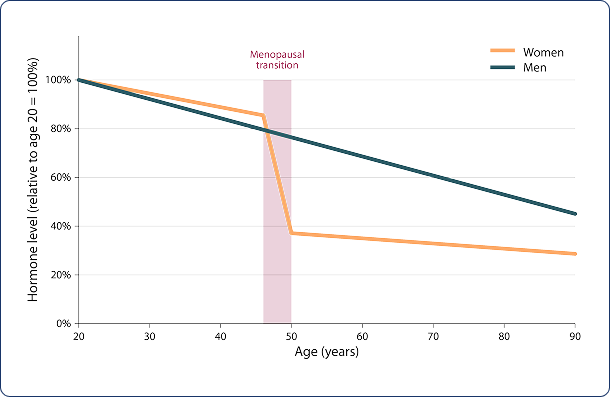
Menopause is an abrupt endocrine milestone, defined by the final menstrual period.1 Her transition unfolds over several years.1,2 Age- and comorbidity-related male hypogonadism is a gradual decline across decades.3,4
The two trajectories are rarely considered together.
Hormonal changes and their potential impact on relationships
Hormonal changes may be associated with symptoms that affect the relationship.5,6 These experiences can also be influenced by psychological and other health factors.6 Our aim is to encourage open conversations about these symptoms and their potential impact on individuals and
their relationships.
What we know today
Partners show measurable, though modest, synchrony in cortisol, autonomic tone and sleep.10,11 They also share many of the exposures that shape these systems, because cardiovascular risk factors cluster within households.12,13
Cortisol

Autonomic tone

Sleep

Certain health conditions may not exist in isolation. Could a couple’s health be measured as one outcome?
Spousal concordance in cardiovascular risk factors and health behaviours is documented across large cohorts.12,13 Concordance describes what is measured together. It is not evidence of transmission between partners, and it does not establish causation.14
Three findings show what that interdependence looks like in practice
1.88
Pooled odds ratio (OR) for type 2 diabetes where a spouse is affected, across 489,798 participants. In older English couples, both partners are hypertensive in 47.1% of cases.13,15
3 to 11×
In 3,722 couples aged 50 and over, a positive change in health behaviour was three to eleven times more likely when the other partner had newly changed.16
9%
In an international survey across 29 countries, fewer than one in ten adults aged 40 to 80 had ever been asked about sexual health at a routine visit.17

Their habits end up on the same path. Their hormones might not.1–4,12,13
Why this matters in the consultation
The considerations below follow from existing evidence and guidelines. The partner and the relationship context can sometimes provide clinically relevant information about the patient in front of you.
Why this matters in the consultation
- Sexual health is an important indicator of quality of life, and is closely linked to cardiovascular, mental and overall wellbeing18,19
- Menopause consultations often focus on vasomotor symptoms and genitourinary syndrome of menopause. Yet women report changes in sexual desire and sexual wellbeing among the most distressing consequences6
- Dyspareunia frequently reflects untreated genitourinary syndrome of menopause20
- In male partners, erectile dysfunction independently predicts cardiovascular disease21
Asked about routinely, these can potentially change what you screen for.21
- A partner’s health status can provide additional information about your patient12,13
- Sexual difficulties in one partner are associated with sexual difficulties in the other. When relevant, asking about the partner context may help identify additional factors affecting sexual wellbeing22
- Chronic illness and commonly used medications, including SSRIs and SNRIs, some antihypertensives and aromatase inhibitors, may contribute to sexual difficulties in either partner23–25
- Patients rarely raise any of this themselves, so asking is often the only way it surfaces17
- These are suggested prompts for assessment, not a treatment protocol. Each partner’s care remains their own
The considerations below follow from existing evidence and guidelines. The partner and the relationship context can sometimes provide clinically relevant information about the patient in front of you.
What are we exploring next?
Existing evidence shows concordance between partners across several health risks and behaviours. Whether measuring and treating them together changes outcomes is not yet known.
- Does a dyadic endpoint predict multimorbidity, frailty and disability-free survival better than individual measures?
- Which domains belong in the Index, and how should they be weighted?
- Does couple-aware care outperform individual care, which no trial has yet tested?14
Follow the science as it develops
Approaches to treatment
Explore treatment planning for both individuals across the Hormone Academy



- Harlow SD, Gass M, Hall JE, et al. Executive summary of the Stages of Reproductive Aging Workshop +10: addressing the unfinished agenda of staging reproductive aging. Menopause. 2012;19(4):387–395.
- Sowers MR, Zheng H, McConnell D, Nan B, Harlow SD, Randolph JF Jr. Estradiol rates of change in relation to the final menstrual period in a population-based cohort of women. J Clin Endocrinol Metab. 2008;93(10):3847–3852.
- Camacho EM, Huhtaniemi IT, O'Neill TW, et al. Age-associated changes in hypothalamic–pituitary–testicular function in middle-aged and older men are modified by weight change and lifestyle factors: longitudinal results from the European Male Ageing Study. Eur J Endocrinol. 2013;168(3):445–455.
- Fabbri E, An Y, Gonzalez-Freire M, et al. Bioavailable testosterone linearly declines over a wide age spectrum in men and women from the Baltimore Longitudinal Study of Aging. J Gerontol A Biol Sci Med Sci. 2016;71(9):1202–1209.
- Beaulieu N, Bergeron S, Brassard A, Byers ES, Péloquin K. Toward an integrative model of intimacy, sexual satisfaction, and relationship satisfaction: a prospective study in long-term couples. J Sex Res. 2023;60(8):1100–1112.
- Metcalfe KB, Meston CM. A scoping review of the biopsychosocial factors influencing sexual desire in menopause. Sex Med Rev. 2026;14(1):qeag009.
- The 2022 Hormone Therapy Position Statement of The North American Menopause Society Advisory Panel. Menopause. 2022;29(7):767–794.
- The NAMS 2020 GSM Position Statement Editorial Panel. The 2020 genitourinary syndrome of menopause position statement of The North American Menopause Society. Menopause. 2020;27(9):976–992.
- Corona G, Maggi M. The role of testosterone in male sexual function. Rev Endocr Metab Disord. 2022;23(6):1159–1172.
- Mayo O, Lavidor M, Gordon I. Interpersonal autonomic nervous system synchrony and its association to relationship and performance: a systematic review and meta-analysis. Physiol Behav. 2021;235:113391.
- Yu YL, Juster RP. Spousal synchrony in allostatic load among older couples in the Health and Retirement Study. Psychosom Med. 2023;85(8):716–726.
- Di Castelnuovo A, Quacquaruccio G, Donati MB, de Gaetano G, Iacoviello L. Spousal concordance for major coronary risk factors: a systematic review and meta-analysis. Am J Epidemiol. 2009;169(1):1–8.
- Varghese JS, Lu P, Choi D, et al. Spousal concordance of hypertension among middle-aged and older heterosexual couples around the world. J Am Heart Assoc. 2023;12(24):e030765.
- Kowall B, Rathmann W. Partnership and marriage and risk of type 2 diabetes: a narrative review. Diabetologia. 2025;68(4):704–714.
- Appiah D, Schreiner PJ, Selvin E, Demerath EW, Pankow JS. Spousal diabetes status as a risk factor for incident type 2 diabetes: a prospective cohort study and meta-analysis. Acta Diabetol. 2019;56(6):619–629.
- Jackson SE, Steptoe A, Wardle J. The influence of partner's behavior on health behavior change: the English Longitudinal Study of Ageing. JAMA Intern Med. 2015;175(3):385–392.
- Moreira ED Jr, Brock G, Glasser DB, et al; GSSAB Investigators' Group. Help-seeking behaviour for sexual problems: the Global Study of Sexual Attitudes and Behaviors. Int J Clin Pract. 2005;59(1):6–16.
- World Health Organization. Sexual health. Geneva: WHO; 2025. Available from:https://www.who.int/health-topics/sexual-health.
- Piegza M, Smolarczyk J, Piegza J. Sexual and cardiovascular health: factors influencing the quality of sexual life of coronary heart disease patients, a narrative review. Vasc Health Risk Manag. 2025;21:51–60.
- Simon JA, Nappi RE, Chedraui P, et al. Genitourinary syndrome of menopause (GSM): recommendations from the Fifth International Consultation on Sexual Medicine (ICSM 2024). Sex Med Rev. 2026;14(1).
- Mostafaei H, Mori K, Hajebrahimi S, Abufaraj M, Karakiewicz PI, Shariat SF. Association of erectile dysfunction and cardiovascular disease: an umbrella review of systematic reviews and meta-analyses. BJU Int. 2021;128(1):3–11.
- Chew PY, Choy CL, Sidi H, et al. The association between female sexual dysfunction and sexual dysfunction in the male partner: a systematic review and meta-analysis. J Sex Med. 2021;18(1):99–112.
- Serretti A, Chiesa A. Treatment-emergent sexual dysfunction related to antidepressants: a meta-analysis. J Clin Psychopharmacol. 2009;29(3):259–266.
- Manolis A, Doumas M, Ferretti A, Agabiti Rosei E, Nilsson PM, Mancia G. Antihypertensive treatment and sexual dysfunction. Curr Vasc Pharmacol. 2020;18(1):43–60.
- Fallowfield L, Cella D, Cuzick J, Francis S, Locker G, Howell A. Quality of life of postmenopausal women in the ATAC adjuvant breast cancer trial. J Clin Oncol. 2004;22(21):4261–4271.
Relationship health – CoupleSpan. Intended for healthcare professionals. This content is for scientific and educational exchange and does not constitute clinical advice for an individual patient. Prescribing decisions remain the responsibility of the treating clinician, in line with locally approved product information. Testosterone is not approved for use in women in most jurisdictions; where it is used in countries without a licensed treatment option, it is used off label.